Water Sort! 3D Color Match Puz
- 4.9
- Rating
- 1.00M
- Installs
- Free
- Price

 Analysis by App-foxy
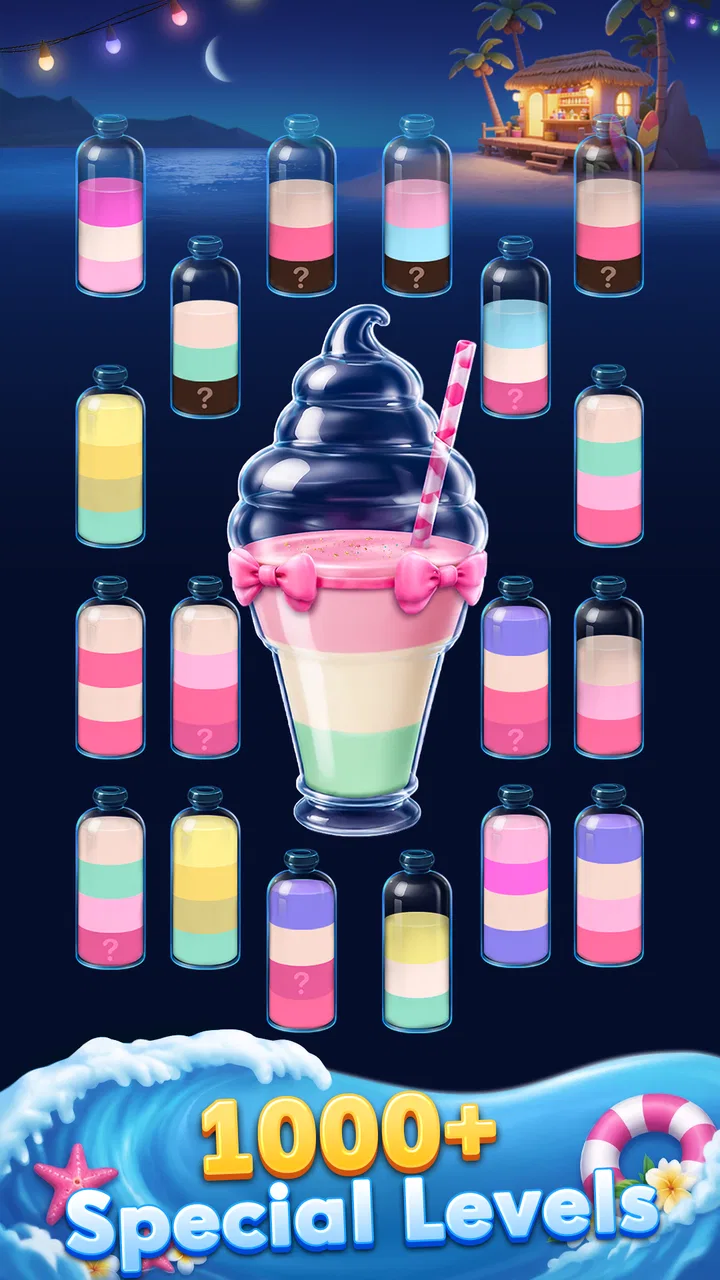
Water Sort! 3D Color Match Puz is the kind of puzzle I can open without preparing myself for a long session. The board presents colored liquid in transparent bottles, and the goal is to organize matching colors by pouring from one bottle into another. It sounds simple, but each move changes the space available for the next one, so a careless pour can turn an easy-looking level into a small exercise in planning.
I found the appeal in that balance between immediate understanding and gradual difficulty. There is no complicated story to learn or large control scheme to memorize. You tap a bottle, choose where the liquid should go, and watch the layers move in a polished three-dimensional presentation. The colorful visuals and soft pouring feedback give it a calm, tactile character, while the puzzle structure keeps it from becoming completely passive.
My first impression is that this is best enjoyed as a short-session sorting game, especially when I want something quiet during a break, while waiting for an appointment, or before going to sleep. It is free to install, suitable for Everyone, and developed by Flyfox Games. The game has reached over a million installs and holds a 4.9 average from around 39 thousand ratings, which fits my impression that its simple format is easy for a broad audience to pick up.
You May Also Like

 Blood Strike: 2.5 Anniversary
Blood Strike’s Loadouts Turn Every Drop Into a Tactical Gamble
A close look at Blood Strike’s custom loadouts: how fast access to signature weapons reshapes its battle royale rhythm, rewards preparation, and narrows the gap between fights.

 Pandora - Music & Podcasts
Pandora’s Music Is Easy to Start, but Harder to Recover
Pandora’s strength is its low-effort path from a seed to a station. Its weak spot is how much confidence it asks you to place in connection, setup, and quiet recovery.

 8 Ball Pool
 Is Built on Rivalries, Rematches, and Routine
A close look at the rivalries, rematches, shared routines, and unanswered safety questions that turn a quick pool match into a persistent mobile community.

 Samsung Music
’s Quiet Strength Is Playing What You Already Own
Its reach comes less from spectacle than from dependable access to a personal library. That simplicity is both the app’s strongest retention engine and its ceiling.

 AccuWeather: Weather Radar
AccuWeather Review: A Quick, Clear Forecast for Everyday Decisions
For everyday plans, the best forecast is the one you can understand quickly. AccuWeather makes rain timing, radar, and local conditions easy to act on, with a few trade-offs.

 Hill Climb Racing
Why Hill Climb Racing Still Turns Crashes Into One More Run
A tiny car, a bumpy hill and one more upgrade: Hill Climb Racing keeps resurfacing because its simple chaos makes every near-miss feel personal.
More From Our News Desk



What the first few minutes feel like
When I start, the important thing is not speed. The opening puzzle teaches the central habit: look at the full arrangement before touching a bottle. A bottle may show several colors stacked vertically, and the upper color is the one that can move first. If the receiving bottle already has that same color at the top, the pour can combine the layers and create room elsewhere. If not, I need an empty bottle or another legal destination.
That makes the first meaningful success more satisfying than simply tapping through a tutorial. I usually pause, identify a color that is already partly exposed, and decide which bottle can accept it. After a few careful moves, two matching sections join, one container becomes more useful, and the board starts to open up. The puzzle feels less like guessing and more like clearing a path through a crowded shelf.
The three-dimensional presentation helps me read the bottles, although it also means I need to pay attention to the visible order of the liquid. The game is not asking me to react quickly. It rewards a calm scan from top to bottom. My practical advice for a first attempt is to avoid moving a color merely because the destination is available. First ask whether that pour exposes a color you can use immediately afterward.
A simple routine for the first successful solve
I use a small routine that makes the early levels feel much less intimidating. I first locate any bottle with an empty space and note which colors are visible at the top of the other bottles. Then I look for a matching pair that can be joined without burying a color I still need. Only after that do I consider moving a single layer to create access.
This order matters because the empty bottle is not just spare storage. It is temporary working space. If I fill it too early with a color that has no immediate partner, I may lose the flexibility needed for the rest of the board. Treating the empty container as a tool rather than a destination is one of the first useful insights I took from the game.
Another helpful habit is to think one pour beyond the move I want to make. Before tapping, I ask myself what color will be exposed afterward and whether that color has somewhere sensible to go. This prevents the common beginner mistake of making a legal move that is strategically unhelpful. A move can be allowed by the rules and still make the next three moves worse.
When a level begins to feel tangled, I do not immediately restart. I inspect which bottle became blocked and trace the decision that caused it. Often the problem is not the latest move but an earlier choice that used the only flexible space. That short review teaches the board’s logic and makes the next attempt more deliberate.
How the controls and visual feedback guide you
The interaction is straightforward enough for a first-time player. Tapping selects the bottle I want to use, and a second choice determines where the liquid should go. The visible layers make the result easy to follow, which is useful because the entire puzzle depends on knowing what is currently exposed. I never felt that I needed a separate explanation of the basic action.
The 3D style gives the liquid a little more presence than a flat row of colored blocks would have. That presentation is part of the relaxation factor, but it can also make me linger on the animation instead of planning the next move. For that reason, I play with a deliberate rhythm: inspect the board while the pour is happening, then make the next decision only when the new arrangement is clear.
Players who prefer rapid tapping may find this slower than other casual puzzle formats. I see that as a deliberate trade-off rather than a flaw. The game works best when I let the board settle and use the visual feedback to confirm what changed. It is less suited to someone looking for fast reactions, timed pressure, or constant action.
Common confusion and how I handle it
The biggest early confusion is assuming that any bottle can pour into any other bottle. The receiving bottle needs to be useful for the color being moved, and the available space matters. A bottle that looks nearly empty may still be a poor choice if its exposed color does not match the liquid I am carrying. Once I focus on the top layer rather than the whole bottle, the rules become much clearer.
I also had to adjust to the fact that combining colors is not always the best immediate move. Joining two matching sections feels productive, but it can cover access to another color or consume space that would be more valuable later. The strongest move is often the one that preserves options, not the one that produces the largest visible stack.
Another point worth understanding is that an empty bottle can be temporarily filled and later emptied again through careful rearrangement. I initially treated an empty space as something to protect at all costs. In practice, it is more useful to think of it as a buffer. The risk is not using it; the risk is using it without a plan for recovering the space.
When I get stuck, I check three things before blaming the level. Did I place a color on top of a different color when another destination was available? Did I use an empty bottle for a color that could not be completed soon? Did I move a bottle simply because it was selectable, without considering what it would reveal? These questions usually identify the mistake faster than random experimentation.
The game’s relaxed presentation can make a difficult position feel more forgiving than it really is. There is no dramatic warning that a move has damaged the solution, so I have to supply that awareness myself. This is where the puzzle’s calm personality and its strategic demand meet: it looks soothing, but it still expects me to plan.
Where the game fits among sorting puzzles
Compared with a basic two-dimensional color-matching puzzle, this game puts more emphasis on the bottle arrangement and the physical sense of pouring. That makes each move easier to understand visually, but it may also feel less compact to players who prefer a minimal interface. Compared with match-three games, it has no need for quick combinations or chain reactions. My progress comes from organization rather than speed.
It also differs from number puzzles because the challenge is spatial and sequential. I am not calculating a score or searching for a mathematical pattern. I am managing access, storage, and order. That makes it a good alternative when I want a puzzle with clear rules but do not want the pressure of a countdown or the visual noise of a more action-oriented format.
On the other hand, people who enjoy deep logic systems, elaborate level variety, or a strong narrative may find the format narrow. Its pleasure comes from refining the same basic sorting idea across increasingly awkward arrangements. If repeating a familiar mechanic is likely to bore you, a story-driven puzzle adventure or a more experimental logic game may be a better choice.
Practical use in everyday play
I can see myself using Water Sort! 3D Color Match Puz in several small gaps during the day. During a short commute, I might solve one board and stop before the session becomes distracting. At home, it works as a gentle transition between demanding tasks because the rules are simple enough to enter quickly, but the planning gives my attention something concrete to do.
It is also a reasonable choice for shared casual play with a child or a family member, since the content rating is Everyone and the basic objective is easy to explain. I would still let the younger player make the decisions rather than solving every board for them. The useful lesson is not only matching colors; it is learning to wait, inspect options, and accept that a tempting move may not be the right one.
For a first-time user, I recommend starting with a quiet five-minute session rather than trying to rush through many levels. Use the opening boards to learn how much liquid can move, how the top layer controls the action, and how an empty bottle changes the available choices. Once those ideas feel natural, later puzzles become more approachable because the difficulty comes from arrangement, not from hidden controls.
The game is free, which makes trying it low-risk. It includes in-app purchases ranging from $0.99 to $9.99 per item, so I would pay attention to any purchase prompt and decide in advance whether I want to spend anything. For me, the core appeal is the puzzle loop itself, and I would not install it expecting a completely purchase-free experience simply because the initial download costs nothing.
Device expectations and version context
The current version is 1.1.6, and it supports devices running Android 7.0 or later. That makes it accessible to many older Android phones as well as newer models. I would still prefer a screen large enough to distinguish the liquid layers comfortably, especially for anyone with reduced eyesight or who finds small touch targets tiring.
Because the game relies on tapping and reading stacked colors, a responsive screen matters more than high-end gaming hardware. I do not approach it like a graphics-heavy action title. The important question is whether the device lets me select bottles accurately and view the arrangement without strain. If the display is cramped, the 3D presentation may become less relaxing than it is on a roomier phone.
The visual design also makes color recognition important. Players with color-vision difficulties may need to take extra care when several shades appear close together. I would recommend trying the opening puzzles first and checking whether the bottle contents are easy to distinguish personally. A puzzle based on color sorting is only enjoyable when the visual information remains readable.
Small strategies that make later boards fairer
My most useful strategy is to protect partially completed colors. If two sections of the same color are already aligned, I try not to disturb them unless doing so creates a clear advantage. Breaking a useful stack for a short-term gain can leave the board with fewer safe destinations. Preserving progress is often more valuable than making the board look active.
I also separate “access moves” from “completion moves.” An access move exposes a color that was hidden; a completion move combines a color with its matching section. Keeping those purposes distinct helps me judge whether a move is actually advancing the solution. If I am making several access moves in a row without creating a new destination, I know I may be spending space without improving the position.
A third technique is to reserve the most flexible bottle for the most constrained color. If one color appears buried under several others, it may need more temporary handling than a color already visible at the top. I avoid filling every spare container with easy matches because that can leave no room for the awkward color when it finally becomes accessible.
I do not treat a restart as failure. In a sorting puzzle, a restart can be a way to test a different opening order after I understand the board better. The important part is to change a specific decision, such as delaying the use of an empty bottle or preserving a mixed stack, rather than repeating the same sequence and hoping it works this time.
These habits are especially useful for players who want a more thoughtful experience from a casual game. They turn the activity from random tapping into a small planning exercise. At the same time, I would not overanalyze every opening board. The game is meant to be approachable, and part of its charm is discovering the solution through a few calm experiments.
Who should try it and who should skip it
I would recommend it to someone who likes orderly visual puzzles, short sessions, and mechanics that can be understood almost immediately. It suits players who enjoy the satisfaction of clearing a messy arrangement one careful pour at a time. It is also a good fit for anyone who finds soft visual feedback more inviting than flashing effects or competitive pressure.
I would be more cautious about recommending it to players who need constant novelty. The bottle-sorting foundation is the entire experience, so its value depends on whether that loop remains satisfying as the arrangements become more demanding. Someone seeking a story, character development, online competition, or fast reflex challenges should look elsewhere.
I would also skip it when I am in the mood for a puzzle that gives me a single dramatic “aha” moment and then moves on to a completely different idea. Here, the enjoyment is cumulative. I learn to read the board more efficiently, use temporary space more wisely, and avoid blocking important colors. That is rewarding, but it is a specific kind of reward.
For families, the Everyone rating makes the game approachable, but the best experience still depends on patience. A child who enjoys arranging colors may find it absorbing, while a child who wants immediate rewards could lose interest when a board requires several setup moves before the solution becomes visible.
My recommendation after spending time with it
Water Sort! 3D Color Match Puz succeeds because it does not hide its central idea behind unnecessary complexity. I can understand the objective quickly, make a first useful move within minutes, and gradually develop better habits as the bottles become harder to organize. The 3D presentation gives the familiar sorting format a pleasant physical feel, while the quiet pace leaves room for actual thought.
Its limitations are equally clear. The core mechanic may feel repetitive, color readability will matter from device to device, and the free model includes optional purchases from $0.99 to $9.99 per item. It is not the right choice for someone wanting a rich adventure or high-energy competition. I also would not recommend rushing through it, because hurried taps undermine the careful planning that makes the puzzles enjoyable.
For a first-time user, the path is reassuring: install the free game on a compatible Android device, inspect the top layers, use the empty bottle as working space, and aim for one deliberate combination rather than a perfect opening. Once that first successful action makes the board more open, the rest of the experience becomes easier to understand.
My final view is positive, with a clear condition: enjoy it as a calm sorting challenge, not as an endlessly varied puzzle collection. Its strongest quality is the feeling of turning visual clutter into order through a few well-chosen moves. If that small sense of control appeals to you, Water Sort! 3D Color Match Puz is an easy game to keep available for short, focused breaks.
FAQs for Water Sort! 3D Color Match Puz
01What is the objective of Water Sort! 3D Color Match Puz?
Water Sort! 3D Color Match Puz is a puzzle game where the main objective is to sort colored liquids into individual bottles until each bottle contains only one color. The game challenges your problem-solving skills as you figure out the most efficient way to sort the colors using the fewest moves possible.
02Is Water Sort! 3D Color Match Puz suitable for all ages?
Yes, Water Sort! 3D Color Match Puz is designed to be suitable for players of all ages. Its intuitive controls and simple rules make it accessible for younger players, while the increasing difficulty levels offer a challenge for adults. It’s a great way to improve cognitive abilities in a fun and engaging way.
03Does Water Sort! 3D Color Match Puz require an internet connection?
Water Sort! 3D Color Match Puz can be played offline, making it an ideal choice for those who want to enjoy gaming without relying on an internet connection. However, some features like updates or additional content may require a connection to download or access.
04Are there in-app purchases in Water Sort! 3D Color Match Puz?
Yes, Water Sort! 3D Color Match Puz offers in-app purchases. Players can buy hints or remove ads to enhance their gaming experience. While the basic version of the game is free, these optional purchases can help if you get stuck or prefer an ad-free experience.
05What are the system requirements for Water Sort! 3D Color Match Puz?
Water Sort! 3D Color Match Puz is available on both Android and iOS platforms. For Android users, a device running Android 5.0 or higher is recommended, while iOS users should have iOS 10.0 or later. Ensure your device has enough storage space for seamless gameplay.
Pros
- Intuitive and easy to understand gameplay.
- Visually appealing 3D graphics.
- Challenging levels that increase in difficulty.
- Offline play available
- no internet needed.
- Frequent updates with new levels and features.
Cons
- Ads can be intrusive and frequent.
- Limited hints without in-app purchases.
- Repetitive music can become annoying.
- Progress can be slow without purchases.
- Some levels may feel overly difficult.

Water Sort! 3D Color Match Puz
Gallery